 Livermore Sub-Zero Repair
★★★★★
Our Sub-Zero wine unit kept throwing a high-temp alarm. They read the code against the exact model, compared display to a probe reading, and replaced a thermistor for $320 instead of the whole board. Diagnostic was $145.
Janet S.Proud Country
Technical guide
Sub-Zero alarms are read by model and serial, not a generic code chart. Real behaviors are a flashing or solid "Service" indicator, the "Vacuum Condenser" reminder, a door-ajar or over-temp alarm, fresh-food-warm airflow symptoms, or a blank display. In dusty Livermore and Sunol, verify each by family before quoting a part.
A control board, thermistor, or display alarm can be real, intermittent, or caused by temperature conditions elsewhere in the system. Confirmation means comparing actual probe readings, checking fans and door closure, and seeing whether the control responds correctly. What cannot be known before inspection is whether a displayed warning is the root problem or a symptom of airflow, seal, or cooling-system trouble.
Codes list
Sub-Zero shows behaviors and service lights, not a universal numeric chart. Use this list as a direction only, then verify by model and serial before any part is named.
| Alarm / display behavior | What it usually points to | What to do |
|---|---|---|
| Flashing or solid "Service" indicator | A stored fault, sensor, or control-board issue held in memory. | Photograph it; verify the exact meaning by model and serial before replacing anything. |
| "Vacuum Condenser" reminder or long run times | Restricted condenser airflow — common after dry, dusty weeks near Livermore's vineyard roads and Tesla Road. | Pull the grille, clean the coil, confirm the fan spins, then re-probe temperatures. |
| Door-ajar / over-temp alarm after Livermore heat | Door left open in summer heat, gasket leak, or a recovery cycle after a warm-load event. | Run a full cycle, check the seal with a paper-drag test, then re-probe before assuming a sensor fault. |
| Fresh-food warm, freezer still cold | Evaporator fan, frosted coil, or damper airflow problem. | Note both compartment temperatures; needs evap and airflow inspection, not a reset. |
| Blank or frozen display, unit still running | Control board, connector, or power-supply fault. | Trained electrical and board checks; do not pull panels yourself. |
| Newer EC-style alphanumeric codes | Model-specific fault on later control platforms; meaning is not universal. | Record the exact characters shown and verify by model/serial against service literature. |
No invented numbers here: where a meaning is not universal, confirm it by your exact model and serial. Reach a Livermore technician at (925) 940-3576.
A high-temp alarm on a Sunol Sub-Zero in 94550 is a clue, not a parts chart; codes and service lights vary by model and serial, so Livermore Sub-Zero Repair photographs the alarm, compares the display to a probe, and checks the condenser before quoting. Reach a Livermore technician at (925) 940-3576.
Key facts
Photo evidence
Appliance context, model and part proof, and post-repair verification — the kind of documentation a Livermore homeowner should expect from the visit.


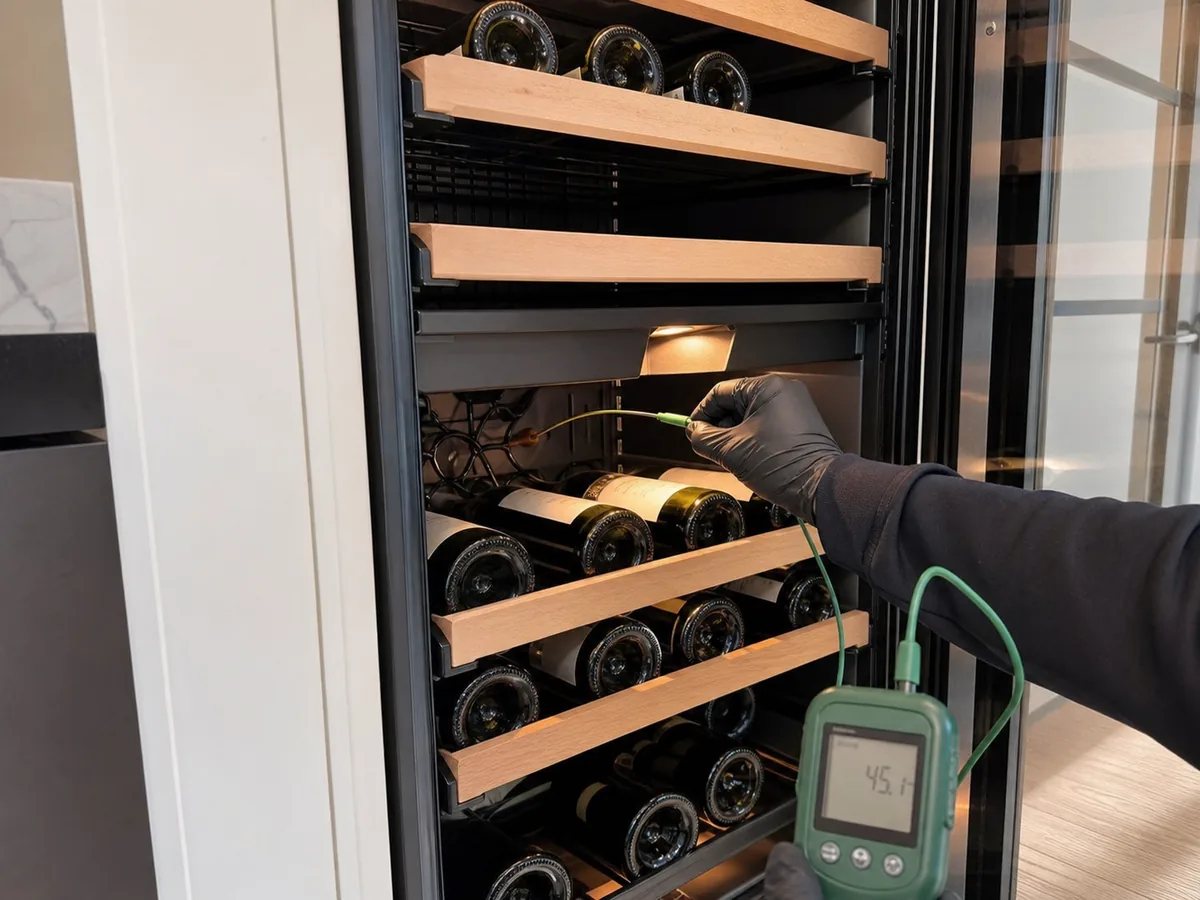
Diagnostic matrix
Sub-Zero symptoms overlap. The table separates visible signs, confirmation tests, false positives, and the likely repair path so the right cause is found before any part is quoted.
| Symptom or clue | What it can mean | Confirmation test | Repair path |
|---|---|---|---|
| High temperature alarm | Door left open, airflow restriction, cooling fault, or sensor issue. | Probe reading and recovery trend. | Correct cause, then clear only after verification. |
| Vacuum condenser message | Dust load or fan/airflow problem. | Inspect grille, coil, and fan movement. | Clean, repair fan if needed, retest. |
| Service light or wrench symbol | Model-specific fault memory or active issue. | Read by model and serial; do not assume universal meaning. | Follow confirmed fault path. |
| Display differs from probe | Thermistor, control calibration, or airflow issue. | Compare actual readings over time. | Sensor/control verification. |
| Door alarm | Door not closing, gasket leak, hinge issue, or switch fault. | Seal, hinge, and switch check. | Adjustment, gasket, or switch repair. |
| Repeated after reset | Underlying issue still active. | Avoid repeated resets; document sequence. | Diagnose root cause. |
| No display, unit running | Power/control/display fault possible. | Electrical and board checks by trained tech. | Repair by model and safety status. |
Livermore price guide
Estimated local ranges for common Sub-Zero built-in work. Exact pricing is confirmed after the on-site diagnostic.
| Service or symptom | What's included | Price range | Typical time |
|---|---|---|---|
| Diagnostic & system inspection | Full cold-side inspection, model/serial check, temperature and airflow readings | $110–$175 | 45-90 min |
| Thermistor / temperature sensor | Sensor replacement, probe-vs-display calibration | $255–$505 | 1-2 hrs |
| Control board diagnosis & replacement | Model-matched board, output testing, post-repair verification | $570–$1,070 | 1-3 hrs |
| Evaporator fan motor replacement | OEM fan motor, airflow and pull-down verification | $330–$615 | 1-2 hrs |
| Defrost system repair | Defrost heater, timer or sensor service, frost-pattern retest | $370–$740 | 2-3 hrs |
What sets the final price: the exact model and serial, how the unit is installed in the cabinet, and what the diagnosis confirms.
Model-specific caution
These notes are intentionally conservative. Any value, code, or part number is confirmed against the exact model and serial before it guides a repair.

Livermore service reality
Sunol and east Livermore routes often include longer drives and homes where a refrigerator has been alarming overnight before anyone notices. That history matters. A screenshot of the alarm, the time it appeared, and the current compartment temperature are more useful than a reset.
Fresh-food warm while freezer still holds needs evidence: temperature readings, condenser and evaporator photos, model-tag proof, and OEM fan, gasket, or control-board evidence. A code chart copied from the internet is not enough for a built-in Sub-Zero decision.
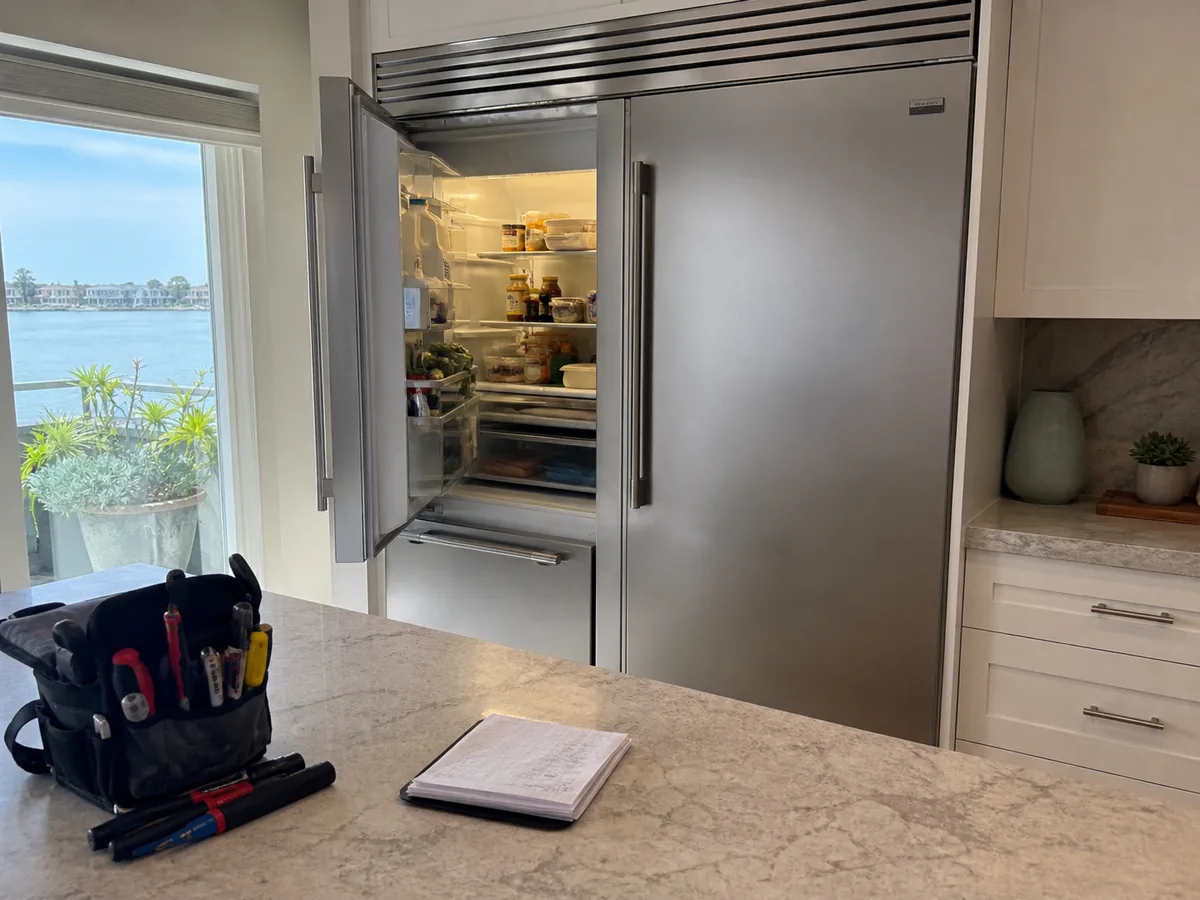
Step by step
Related guides
Explore the related guides for the next detail: model location, cabinet access, heat-load triage, repair costs, repair-versus-replace advice, and how to book a visit.
Customer reviews
Real feedback from Livermore-area homeowners, backed by a wider appliance repair network with more than 700 customer reviews across platforms and a 4.9 average rating.
★★★★★
Our Sub-Zero wine unit kept throwing a high-temp alarm. They read the code against the exact model, compared display to a probe reading, and replaced a thermistor for $320 instead of the whole board. Diagnostic was $145.
Janet S.Proud Country
★★★★★
Sub-Zero 690 service light wouldn't clear. They took my alarm photo seriously, diagnosed a failing control board, and replaced it for $720 with output testing. Very thorough.
Eric P.Downtown Livermore
★★★★★
Sub-Zero 648 threw a vacuum-condenser message after a dusty week. They cleaned the coil and verified the fan for $250 — the alarm was airflow, not electronics. Calm, clear, accurate.
Nina V.South Livermore
Questions from this page
If food safety allows, take a photo first and record the temperatures. A reset may hide timing and recovery clues that help separate door events from actual cooling faults.
No. Codes and display behavior depend on model family and revision. A safe guide explains the possible direction, then verifies by model and serial.
Yes. Restricted airflow can create high temperature warnings or long run times. The condenser condition should be inspected before assuming a board or sealed-system fault.
Still document it if it repeats. Intermittent alarms can point to door closure, fan behavior, sensor drift, or heat-load conditions that are easier to catch with a history.
It usually flags restricted condenser airflow, common near vineyard roads. Clear the grille and check the fan; a coil cleaning runs $205–$395. If the message returns after airflow is restored, the next step is a $255–$505 sensor check or a $570–$1,070 board diagnosis.
No. Repeated resets erase the timing and recovery clues a technician needs. Photograph the alarm, the time, and the temperatures first. A $110–$175 diagnostic then matches the code to your exact model, since alarms vary by family and serial range.