 Livermore Sub-Zero Repair
★★★★★
They documented everything on our Sub-Zero 632 — starting fresh-food temp 48 °F, evaporator fan replaced for $440, verified pull-down back to 38 °F with a probe. I knew exactly what was done and why.
Kevin R.North Livermore
Case-note hub
Livermore Sub-Zero case notes document the model family, the heat or wine-storage context, the temperature evidence, the components tested, the outcome, and whether a second visit or part order was required. They are anonymized, scenario-based examples of how a built-in refrigeration problem is diagnosed and resolved in Livermore homes.
Key facts
What this usually means
Each case note follows the reasoning path: symptom, first test, evidence, repair path, and verification. They are kept anonymous and scenario-based so the diagnostic approach is clear without exposing any private customer detail.
A good note starts with the model family and the local condition. For Livermore, that might be summer heat, vineyard dust, wine-zone drift, cabinet access, event timing, or an older built-in tied to a remodel. The note then records what was tested and what changed after repair or maintenance.
Outcomes are concrete but restrained. A note says whether a temperature trend improved, a fan was verified, a gasket path was confirmed, or a second visit was needed for serial-matched parts.
Service planning table 1
| Scenario | Evidence to document | Outcome format |
|---|---|---|
| Summer not cooling | Temperature pattern, condenser airflow, fan check | Airflow corrected, fan verified or deeper diagnosis needed |
| Wine column drift | Display/probe comparison and zone behavior | Sensor/fan/seal path or protected bottle move |
| Gasket frost line | Gasket photo, hinge and panel contact | Seal replacement or alignment path |
| Ice maker slow | Cube pattern, freezer temp and fill check | Water path, valve/filter or temperature support |
Service planning table 2
| Finding | Same-visit possible when | Part order needed when |
|---|---|---|
| Airflow restriction | Cleaning and fan verification solve trend | Fan or control testing points to a failed part |
| Gasket issue | Adjustment solves closure | Serial-matched gasket profile is required |
| Control suspicion | Reset history or probe comparison clarifies issue | Board or sensor must match model revision |
Service planning table 3
| Prep item | Why it helps | Public note boundary |
|---|---|---|
| Model and serial photo | Prevents wrong part assumptions | Mask private serial digits |
| Temperature log | Shows trend before arrival | No address or owner name |
| Wide cabinet photo | Plans access and protection | Avoid people and private interiors where possible |
Livermore price guide
Estimated local ranges for common Sub-Zero built-in work. Exact pricing is confirmed after the on-site diagnostic.
| Service or symptom | What's included | Price range | Typical time |
|---|---|---|---|
| Diagnostic & system inspection | Full cold-side inspection, model/serial check, temperature and airflow readings | $110–$175 | 45-90 min |
| Evaporator fan motor replacement | OEM fan motor, airflow and pull-down verification | $330–$615 | 1-2 hrs |
| Door gasket / cabinet seal replacement | OEM gasket, hinge and door-swing alignment, seal verification | $375–$715 | 1-3 hrs |
| Ice maker module / harvest repair | Fill and harvest cycle, module or bail-arm service, ice retest | $345–$665 | 1-2 hrs |
| Wine cooler zone repair | Zone fan, thermistor or seal service, probe-confirmed recovery | $355–$815 | 1-3 hrs |
What sets the final price: the exact model and serial, how the unit is installed in the cabinet, and what the diagnosis confirms.
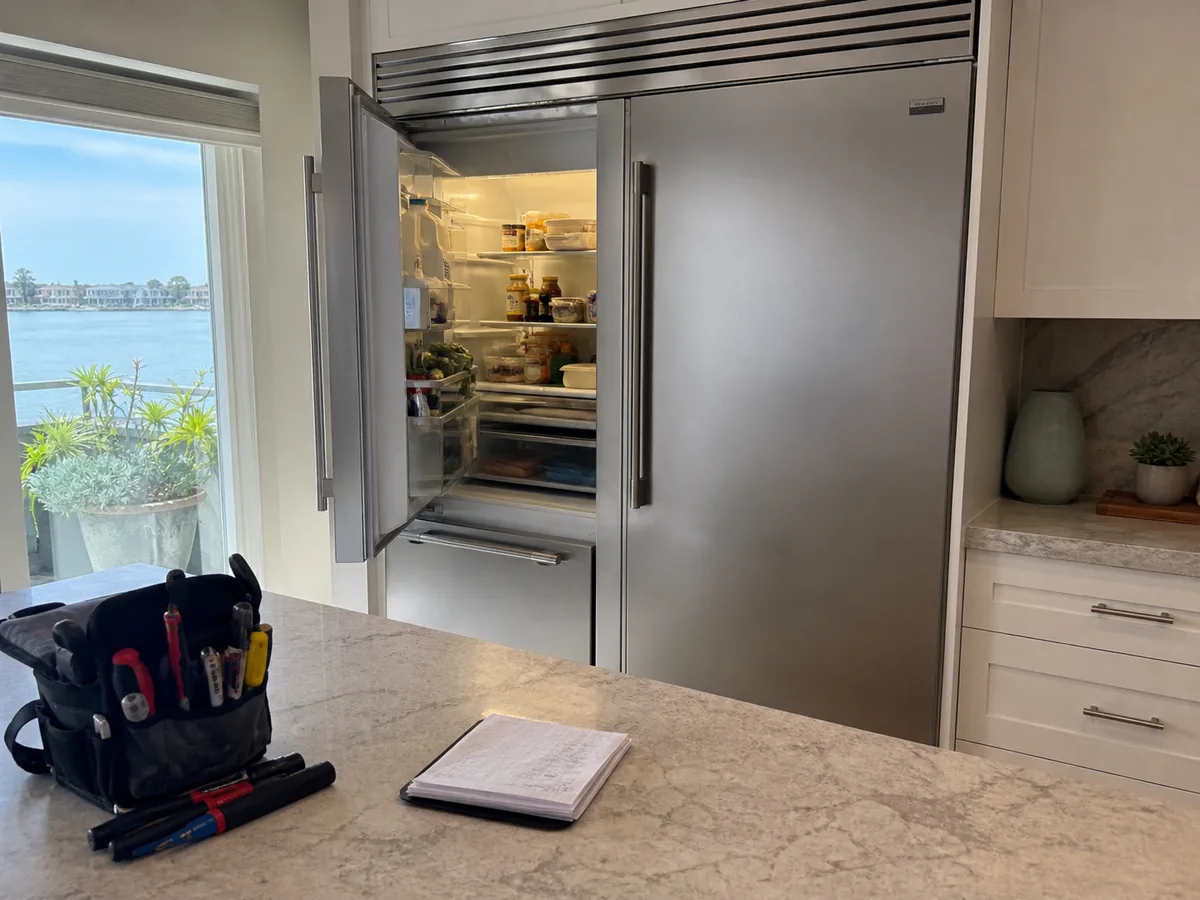
Local notes
Livermore case notes should be local without becoming private. It is useful to mention South Livermore wine-storage context, Sunset older cabinetry, Mendenhall panel-ready access or Ruby Hill area estate kitchens. It is not useful to publish exact addresses or owner-identifying details.
Case notes stay local without becoming private: neighborhood-level context helps explain access and heat load, while addresses and owner-identifying details are never published.
When not to guess
Do not use a case note to imply guaranteed outcomes. The same symptom can have different causes by model, serial range, access and temperature pattern. A case note should show how evidence narrowed the path, not promise the same repair for every future caller.
Model, serial number, and on-site diagnostic evidence determine the final quote, so the visit always confirms the cause before recommending a part.
Step by step
Related guides
Explore the related guides for the next detail: model location, cabinet access, heat-load triage, repair costs, repair-versus-replace advice, and how to book a visit.
Customer reviews
Real feedback from Livermore-area homeowners, backed by a wider appliance repair network with more than 700 customer reviews across platforms and a 4.9 average rating.
★★★★★
They documented everything on our Sub-Zero 632 — starting fresh-food temp 48 °F, evaporator fan replaced for $440, verified pull-down back to 38 °F with a probe. I knew exactly what was done and why.
Kevin R.North Livermore
★★★★★
Clear written notes on our Sub-Zero 648 ice maker repair ($410): the symptom, the scaled inlet valve they found, the part, and the retest. Easy to understand and trust.
Laura P.South Livermore
★★★★★
Evidence-based from start to finish on our Sub-Zero 685 door-gasket job ($500). No guesswork — symptom, seal-compression test, the correct profile part, then verification.
Nathan B.Proud Country
Questions from this page
A useful note includes the model family, model and serial evidence, current temperatures, local heat or wine-storage context, tested components, part path and verification. It explains why the diagnosis was made rather than simply saying the appliance was fixed.
Yes. Notes use neighborhood-level context like South Livermore, Sunset, Mendenhall or the Ruby Hill area to explain access or heat load, while addresses, names, faces and identifiable interiors are never published.
Yes. Fresh-food warm with the freezer holding may be airflow, fan, seal, sensor or control behavior. The model, serial range, heat exposure and cabinet access can change the answer, which is why every note shows the evidence.
Documented cases range from a $110–$175 diagnostic to $355–$815 wine-zone repairs, with evaporator fans around $330–$615 and gaskets $375–$715. Each note ties the symptom and starting temperature to the serial-matched part and the verified result.
They use neighborhood-level context — South Livermore, Sunset, Mendenhall, Ruby Hill — to explain access and heat load, but never publish addresses, names, or identifiable interiors. The value is the diagnostic sequence and the outcome, not private details.
Call or book online first. If requested during scheduling, have the model and serial number, current fresh-food and freezer temperatures, alarm details, and symptom notes ready. For wine storage, include display and independent probe readings by zone if available.