 Livermore Sub-Zero Repair
★★★★★
Our Sub-Zero 642 struggled at 100 °F — recovered overnight, drifted by afternoon. A dust-loaded condenser and a weak seal; the coil clean and gasket came to $620. Recovered fast.
Ellen W.South Livermore
Summer not-cooling hub
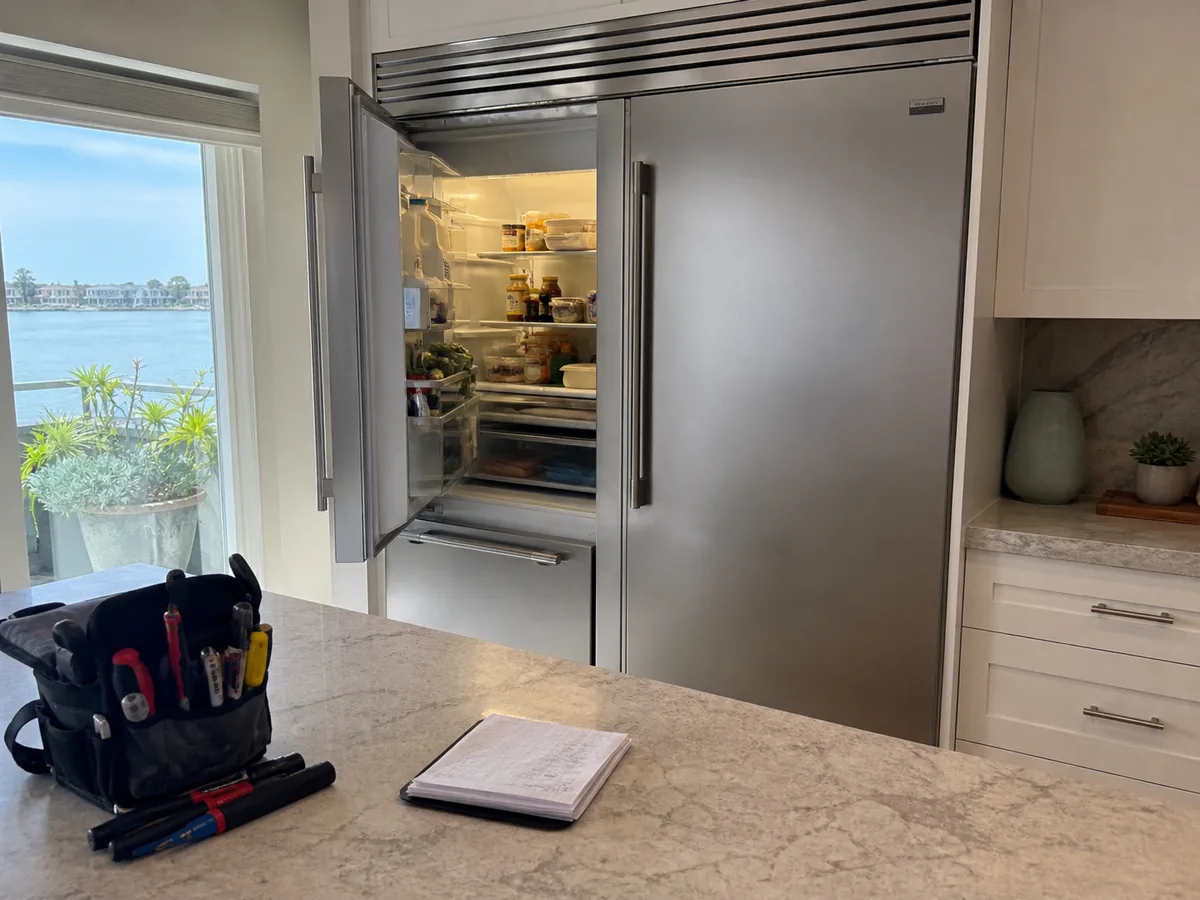
When a Livermore Sub-Zero is not cooling during hot weather, start with condenser airflow, cabinet ventilation, fan operation, door seal and temperature pattern before assuming a sealed-system failure. Sub-Zero not cooling in Livermore often appears first during sustained Tri-Valley heat because a marginal airflow path or weak seal has less recovery room.
When a Ruby Hill Sub-Zero drifts past 95 °F on hot 94551 afternoons but recovers overnight, the cause is usually a dust-loaded condenser, weak fan, or tired door seal starving airflow, not the compressor. Livermore Sub-Zero Repair logs fresh-food and freezer temps to prove it; book your Livermore visit at (925) 940-3576.
Key facts
What this usually means
A summer not-cooling complaint should be sorted by pattern. Fresh-food warm with freezer stable points differently than both compartments warming together. A unit that recovers overnight but drifts in the afternoon may be reacting to heat load, blocked airflow or cabinet ventilation rather than a failed sealed system.
The first test is not a part order. It is a record of actual temperatures, run behavior, condenser access, fan movement, frost or condensation evidence and whether the display matches a separate probe. If a homeowner keeps resetting the unit, those clues can disappear.
A built-in Sub-Zero refrigerator also has cabinet variables. A tight panel reveal, blocked toe-kick, dusty upper grille, heavy door panel or warm appliance bay can make a normally contained issue look bigger. The visit should document what was checked before escalating to control or sealed-system language.
Service planning table 1
| Pattern | Likely path | First test |
|---|---|---|
| Fresh-food warm, freezer holding | Airflow, evaporator fan, damper, thermistor or seal | Record both temperatures and verify fan/air movement |
| Fresh-food warms after door use | Door seal, hinge, panel fit or airflow recovery | Inspect gasket compression and door closure |
| Display differs from probe | Sensor or control interpretation | Compare independent probe reading to control behavior |
Service planning table 2
| Situation | Urgency | Recommended action |
|---|---|---|
| Both sides rising quickly | High food-safety urgency | Move food, record temperatures and schedule diagnosis |
| Warm only in afternoon | Moderate but time-sensitive | Check airflow evidence and cabinet heat pattern |
| Long run time after grocery load | Depends on recovery | Avoid reset; document pull-down trend |
Service planning table 3
| Check | Owner-safe? | Boundary |
|---|---|---|
| Record temperatures and alarm photos | Yes | Do this before reset if safe |
| Look for blocked grille or dust from outside | Yes | Do not bend fins or disassemble panels |
| Fan voltage or control output | No | Technician-only electrical testing |
| Refrigerant, compressor or leak work | No | Qualified sealed-system diagnosis only |
Livermore price guide
Estimated local ranges for common Sub-Zero built-in work. Exact pricing is confirmed after the on-site diagnostic.
| Service or symptom | What's included | Price range | Typical time |
|---|---|---|---|
| Diagnostic & system inspection | Full cold-side inspection, model/serial check, temperature and airflow readings | $110–$175 | 45-90 min |
| Condenser coil cleaning & airflow service | Coil clean, condenser fan check, pull-down retest | $205–$395 | about 1 hr |
| Condenser fan motor replacement | OEM fan motor, run-time and temperature retest | $310–$600 | 1-2 hrs |
| Evaporator fan motor replacement | OEM fan motor, airflow and pull-down verification | $330–$615 | 1-2 hrs |
| Sealed system / compressor repair | EPA-certified leak, charge or compressor work with full verification | $1,055–$2,455 | 4-8 hrs + parts |
What sets the final price: the exact model and serial, how the unit is installed in the cabinet, and what the diagnosis confirms.
Local notes
Livermore heat is strongest around South Livermore Avenue, the Concannon/Wente corridor and the Ruby Hill edge where afternoon sun and large kitchens can keep appliance bays warm. Dust from vineyards and dry summer traffic can also load grilles faster than a homeowner expects.
Downtown Livermore and Sunset homes can have older cabinet openings that were not designed around modern airflow expectations. Mendenhall and newer panel-ready kitchens can hide ventilation restrictions behind a clean face, so a wide cabinet photo is part of the evidence set.
When not to guess
Do not assume the compressor failed because the unit is warm in June, July or August. Rule out condenser airflow, fan movement, door-seal leakage, control readings, cabinet ventilation and reset history before using sealed-system language.
Model, serial number, and on-site diagnostic evidence determine the final quote, so the visit always confirms the cause before recommending a part.
Step by step
Related guides
Explore the related guides for the next detail: model location, cabinet access, heat-load triage, repair costs, repair-versus-replace advice, and how to book a visit.
Related reading
Heat exposes the weak link; these guides chase it down — airflow, alarms, dust, and the plan for a hot guest weekend.
Customer reviews
Real feedback from Livermore-area homeowners, backed by a wider appliance repair network with more than 700 customer reviews across platforms and a 4.9 average rating.
★★★★★
Our Sub-Zero 642 struggled at 100 °F — recovered overnight, drifted by afternoon. A dust-loaded condenser and a weak seal; the coil clean and gasket came to $620. Recovered fast.
Ellen W.South Livermore
★★★★★
Came out during a heat wave for our Sub-Zero 611. Diagnosed airflow, not the compressor; condenser fan replaced for $380. Cooling again same day. Diagnostic was $135.
Chris B.Downtown Livermore
★★★★★
Sub-Zero 690 in a tight panel-ready bay was overheating. They improved ventilation and serviced the condenser for $290. They knew exactly how Livermore summers stress these units.
Maria G.Mendenhall
Questions from this page
The first test is the temperature pattern plus airflow evidence. Record fresh-food and freezer temperatures, note whether the unit recovers overnight, photograph alarms and check whether the grille is blocked from the outside. Those facts guide the technician before any part is discussed.
Yes, heat can expose weak condenser airflow, a marginal fan, a tired gasket or tight cabinet ventilation. It does not identify the failed part by itself. Summer heat changes priority: airflow and temperature recovery should be checked before sealed-system assumptions.
Avoid resetting unless there is a safety reason. Resetting can erase alarm timing, run behavior and frost evidence. If food safety is the concern, move food, record temperatures and photograph the display before changing the unit state.
Yes, dust can restrict condenser airflow and make the unit run longer or recover poorly during hot weather. The proof is not dust alone. The visit should document coil condition, fan movement and temperature response after airflow correction.
Have the model and serial number, display or alarm, wide cabinet view, grille or condenser access if visible, frost or condensation lines and a temperature log. These photos help separate a simple airflow issue from a fan, control or sealed-system path.
It is urgent when both compartments are rising, food is above safe temperatures, alarms repeat, or wine storage drifts beyond tolerance before an event. Move food or wine for safety first, then preserve photos and readings for diagnosis.